Knowledge / Light fundamentals · By BioLight Systems · 1 October 2026 · 5 minute read
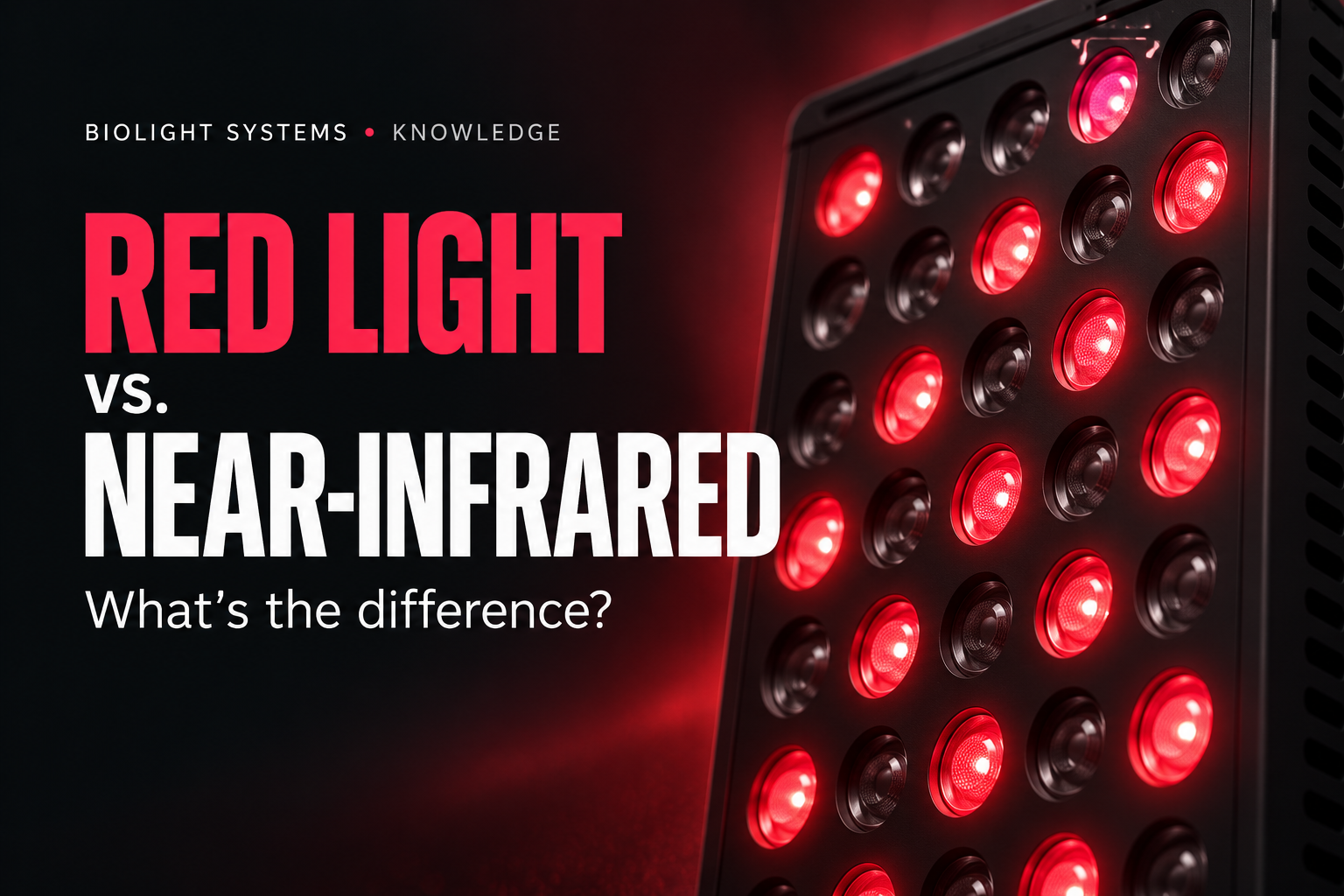
Comparing red light vs. near-infrared light can feel confusing when both appear on the same light therapy panel. The clearest starting point is the light itself: red light is visible, while near-infrared sits beyond the red end of the visible spectrum. A wavelength label describes the light; it does not, on its own, establish a health benefit.
Red and near-infrared are different wavelength ranges. For example, 660 nm is red and 850 nm is near-infrared. Neither number tells you the complete performance, safety or effectiveness of a device. Compare its documented output, intended use and instructions alongside the wavelengths.
Red light vs. near-infrared: key differences
| Feature | Red light | Near-infrared light |
|---|---|---|
| Visibility | Visible as red | Outside normal human vision |
| Example wavelength | 660 nanometres | 850 nanometres |
| What to check | Exact wavelengths and measured output | Exact wavelengths and measured output |
| Does the label prove results? | No | No |
NASA describes infrared as light beyond the visible spectrum. This matters when looking at a panel: an emitter that does not appear bright is not necessarily off. Do not judge near-infrared output by eye or stare into a device to test it. Read NASA’s explanation of infrared light.
What do 660 nm and 850 nm mean?
The abbreviation nm means nanometres, a unit used to express wavelength. In a 2024 photobiomodulation review, researchers describe red light as 620–700 nm and near-infrared as 700–1440 nm. Range boundaries can vary by scientific convention; the exact number on a specification sheet is therefore more useful than a broad colour label. See the photobiomodulation review.
Wavelength is also different from electrical wattage. A model name, LED count or power-consumption figure should not be treated as a measurement of light arriving at your skin. For a practical way to compare the information manufacturers provide, start with our guide to reading a panel specification sheet.
What does research on light therapy actually tell us?
Photobiomodulation is a term used for certain applications of red or near-infrared light. Clinical findings need context: the device, treatment protocol, participants and outcome being measured all matter. A study involving one setup does not automatically validate every home panel with a similar wavelength.
The American Academy of Dermatology notes that some at-home red light studies report skin improvements, but studies use different devices and schedules, making comparison difficult. More research is needed. Read the AAD’s consumer guidance.
Cleveland Clinic likewise describes red light therapy as an emerging treatment with uncertainty around many promoted uses. Treat broad promises about pain, recovery or disease treatment cautiously. A wavelength comparison cannot tell you which treatment is appropriate for a medical condition. Read Cleveland Clinic’s overview.
How to compare a red and near-infrared panel
Use the same checklist for every model on your shortlist. If a specification is missing, ask for it rather than filling the gap with a marketing claim.
- Identify the wavelengths. Look for actual nm values and clear descriptions of the available modes.
- Check measurement conditions. If output is quoted, look for the units, measurement distance and testing method. Keep those conditions consistent when comparing figures.
- Match the format to your space. Consider panel dimensions, mounting, storage and where it will be used. Our panel size guide covers this decision.
- Read the manual before purchase. Check intended use, distance, timing, eye protection and contraindications. Avoid inventing your own routine from a different device’s instructions.
- Separate evidence from presentation. Attractive photography and a long feature list are not substitutes for product documentation or relevant research.
Using a light therapy device responsibly
Follow the specific manufacturer’s directions. The AAD advises using the recommended eye protection when required; sunglasses are not a substitute. If you take medication that increases light sensitivity or have a photosensitive condition, consult a qualified clinician before use. See our first-session setup checklist to organise the practical details.
Frequently asked questions
Is near-infrared the same as red light?
No. They occupy different wavelength ranges. Red light is visible; near-infrared lies beyond visible red. A device can include both, so check the actual specifications.
Is 850 nm better than 660 nm?
There is no universal winner. A wavelength alone cannot establish whether a device is effective for your intended use. Look for relevant evidence and device-specific instructions instead of choosing by the larger number.
Does a brighter-looking panel mean a stronger treatment?
No. Visible brightness does not measure near-infrared output or establish a suitable treatment dose. Use documented specifications and the device manual.
Can I use red and near-infrared together?
Some devices offer a combined mode. Whether and how to use it depends on that device’s instructions and your circumstances. Do not assume that combining modes or extending a session improves results.
Choose with clearer information.
Continue with the panel specification guide, or explore more practical explainers in BioLight Knowledge.
Educational information, not personalised medical advice. This guide does not establish clinical performance for BioLight products. Sources are linked in the relevant sections.